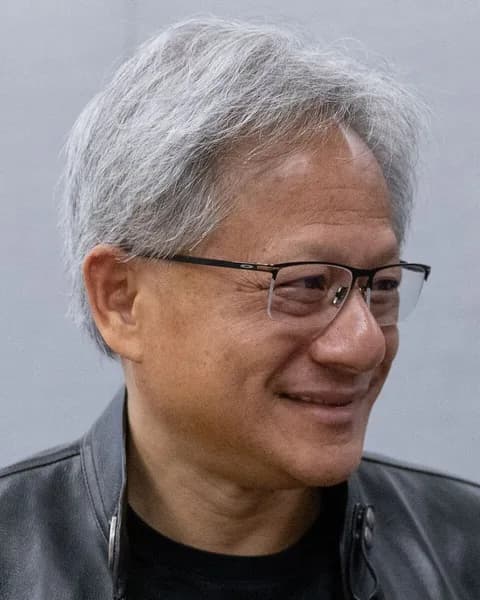
See why he is an Architect
5 moments from his public record that show the Architect pattern.
- In April 1993, Jensen Huang met engineers Chris Malachowsky and Curtis Priem at a Denny's in San Jose. They founded Nvidia to make chips that could bring 3D graphics to ordinary PCs. The market was still early, and Nvidia had no product. Huang set the company's direction before the market was proven. He later said the restaurant “had all the coffee you could drink and no one could chase you out.” [3]
- In 1999, Nvidia launched the GeForce 256 and called it the world's first graphics processing unit. Graphics chips already took work away from a computer's main processor, but Nvidia introduced the term “GPU” for this category. The industry then adopted that name. [9]
- In 2006, Nvidia introduced CUDA, a way to program its graphics chips for general computing as well as games. It kept funding CUDA for almost a decade while its market value stayed between about $8.5 billion and $10 billion. Nvidia spent close to $12 billion on research and development between 2006 and 2017 while revenue remained in the single billions. Engineer Bryan Catanzaro said it took “about 10 years before Wall Street really started to believe this investment was worth anything.” Huang invested in the platform before there was proof that customers outside Nvidia needed it. [4]
- In early 2013, Bryan Catanzaro built cuDNN, a library that helped Nvidia chips train neural networks, after Nvidia's software team had criticised the project. He took it directly to Huang. Huang cleared his weekend to study deep learning. At their next meeting, Huang had written “Once In A Lifetime Opportunity” on his whiteboard and authorised Catanzaro to bring in people from across the company. Huang did not make the AI shift alone. He acted quickly once he saw a working prototype. [5]
- Huang has about 60 direct reports and no scheduled one-to-one meetings. He has said, “I don't have one-on-ones with them because it's impossible. We present a problem, and all of us attack it.” He calls this approach extreme co-design: a flat structure where managers do not hold information that the rest of the company cannot see. [6]
What you can learn from his approach
Practices to use
- Use a long-term priority to guide decisions. During CUDA's flat years, Huang said he asked whether the work was “relevant” and “exquisite”, rather than what the market wanted that quarter. [4]
- Share important decisions with the people who need to act on them. Huang removes management layers between himself and product builders, then speaks to the leadership group together. This helps everyone work from the same information. [6]
Who helped deliver it
- Chris Malachowsky and Curtis Priem co-founded Nvidia with Huang at the Denny's meeting in 1993. They brought the engineering experience Huang needed to build Nvidia's first product. [3]
- Bryan Catanzaro spent years trying to interest Nvidia staff in deep learning. In 2013, he built cuDNN and took it directly to Huang. His persistence and working library gave Huang evidence to change the company's priorities. [5]
What to watch for with the Architect approach
An Architect can treat a finished design as finished work before customers or production have tested it. These examples from Huang's public record show that risk.
- Nvidia unveiled its Blackwell chip family in March 2024 and first expected to ship it by the second quarter. A design flaw later reduced manufacturing yield, so Nvidia worked with manufacturing partner TSMC before large-scale production could resume. Huang said: “We had a design flaw in Blackwell. It was functional, but the design flaw caused the yield to be low. It was 100% Nvidia's fault.” [7]
- A Blackwell computer needed 7 chip types, each designed from scratch and moved into production at the same time. The flaw became public in August 2024. Huang confirmed the fix on 2024-10-23. During those months, Amazon, Google, Meta and Microsoft, customers that together accounted for more than 40% of Nvidia's revenue, waited for delayed shipments. [8]
- The lesson is practical: a design can work on paper and in early samples, but still fail under high-volume manufacturing. Treat the first production run as part of the work, not as proof that the work is complete. [8]
3 practices you can use
3 practices from his public record that you can use this week.
Fund the foundations early. Support the platform beneath your product before the market is ready. Nvidia kept investing in CUDA while its market value barely changed, before AI research created a larger market for it. [4]
Study working proof yourself. When someone brings you a working prototype for an idea you have not backed, make time to understand it before you decide. Huang cleared a weekend to study Catanzaro's cuDNN library rather than delegating the decision. [5]
Give everyone the same information. Flatten the reporting line where you can, then share important decisions with the whole group. This helps people build towards the same outcome instead of relying on private updates. [6]
Avoid complexity for its own sake
Don't copy complexity for its own sake. A complex design is useful only when people can build and ship it reliably.
Blackwell shows the risk. Nvidia launched a design it believed was complete, but it could not build the product at volume until TSMC helped fix a flaw that Huang later called 100% Nvidia's fault. Designing 7 chip types from scratch and bringing them into production together was a difficult task. The problem was treating the design as complete before it had been tested at production scale. Copy Huang's willingness to fund a platform for years before the market catches up. Do not call a design complete until it has shipped reliably at scale. [7] [8]
Sources
Every numbered claim on this page links to one of these.
- [1] Our History: Innovations Over the Years
- [2] Jensen Huang - CHM
- [3] NVIDIA Founder and CEO Jensen Huang Returns to Denny's Where NVIDIA Launched a Trillion-Dollar Vision
- [4] Going all-in with Nvidia: How Jensen Huang's high-stakes bets paid off
- [5] "Once In A Lifetime": The Bryan Catanzaro Story of Nvidia
- [6] Nvidia CEO Jensen Huang Never Has One-on-One Meetings With His 60 Direct Reports, Here's Why
- [7] Nvidia's design flaw with Blackwell AI chips now fixed, CEO says
- [8] Nvidia CEO Jensen Huang: Blackwell AI Chip Design Flaw Fixed
- [9] Nvidia's first GPU: GeForce 256
Find your working style
Get your Profile
Get your Profile in about 10 minutes. It is free, and you can use it straight away.
Start the free Assessment