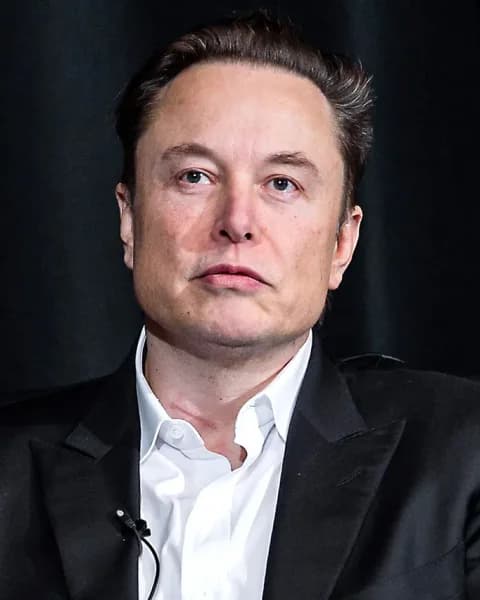
See why he is a Visionary
5 moments from his public record that show the Visionary pattern.
- In 2002, Musk founded SpaceX with the goal of making humanity a multiplanetary species, including a self-sustaining city on Mars. No privately built rocket had reached orbit. He set the outcome before the company had a technical or financial path to achieve it, and before the idea had proved itself in flight. [1]
- SpaceX's first 3 Falcon 1 launches failed between 2006 and 2008, and the company was nearly out of money. On 28 September 2008, the fourth attempt reached orbit. Falcon 1 became the first privately built, liquid-fuelled rocket to do so, keeping the company alive to build towards its larger goal. [2]
- In 2006, while running SpaceX full time, Musk published “The Secret Tesla Motors Master Plan.” It set out a sequence: build an expensive sports car, use its profits and lessons to build a more affordable car, then use that to fund a mass-market car. Tesla followed roughly that order for close to 2 decades. [3]
- On 22 December 2015, a Falcon 9 first stage landed upright on land after delivering its payload to orbit. It was the first orbital rocket booster recovered this way. Musk's public argument that a rocket should not be thrown away after 1 use became a filmed, working result. [4]
- In October 2022, Musk completed a $44 billion purchase of Twitter, immediately fired its CEO, CFO and top legal counsel, and began rebuilding the platform around a new goal: an “everything app” for messaging, payments and AI. [5]
What you can learn from his approach
Practices to use
- He uses a 5-step process before automating a design: question the requirement and name who wrote it, delete what you can, simplify what remains, speed up the cycle, then automate. He has said his biggest mistake at Tesla and SpaceX was automating before he had deleted and simplified, because that locks in waste. [7]
- He sets a public destination in 1 clear sentence, then changes the business to support it. When Twitter became X in 2023, “the everything app” gave the newsroom, product team and outside observers a simple reference point for later decisions, and a way to judge whether the work still matched the claim. [6]
Who helped deliver it
- Gwynne Shotwell joined SpaceX in 2002 as 1 of Musk's first hires. Since 2008, she has run the company day to day as president and COO. Colleagues describe her as the person who manages Musk and turns his direction into day-to-day work, which is what keeps the company operational. [8]
- JB Straubel co-founded Tesla and served as its chief technology officer from 2005 to 2019. He led cell design, the drivetrain and the original Gigafactory concept through the Model 3 production ramp. This was the technical work behind the public roadmap Musk announced, and it is the part that turned the bigger plan into something buildable. [9]
What to watch for with the Visionary approach
A Visionary can set bigger goals before the team has a clear plan, funding or timeline to reach them. These examples from Musk's public record show the risk in more than one setting.
- Starting in 2013, Musk said Tesla “should be able to do 90% of miles driven” autonomously within 3 years. He repeated versions of the promise for more than a decade: complete autonomy in “approximately two years” in 2015, full autonomy “this year” in 2023, and 4 robotaxi deadlines since 2025. Each deadline passed without the promised capability arriving on the stated date. [10]
- In August 2018, Musk tweeted that he had “funding secured” to take Tesla private at $420 a share. He had spoken with Saudi Arabia's sovereign wealth fund, but he had not secured committed funding. Tesla was never taken private. [11]
- In October 2018, Musk and Tesla each agreed to pay $20 million in civil fines to settle the SEC's securities fraud case. Musk stepped down as Tesla's chairman and agreed to have a company lawyer review his Tesla-related tweets before he sent them. He continued to challenge that requirement in court for years. [11]
- While leading the federal Department of Government Efficiency in 2025, Musk's team publicised deep cost cuts, including $6.4 billion claimed from cancelling 3 federal health contracts. A CBS News analysis found savings of about $165 million on those contracts, less than 3% of the claimed figure. It also found that roughly half of DOGE's other savings claims lacked documentation. [12]
- These examples show the same risk across different kinds of work: full autonomy, a private Tesla and a dramatically smaller federal budget were announced before the previous version had been delivered. The gap between an announcement and a working result appeared across cars, a company takeover and a government initiative. [10]
3 practices you can use
Set a clear destination before you have the full plan. In 2002, Musk stated “make humanity multiplanetary” as SpaceX's goal, when the company had no rocket that had reached orbit. This gave the team a clear way to judge whether today's work supported the goal. [1]
Before you automate or optimise a step, ask who wrote the requirement and question it by name, not by department. Musk's 5-step process puts deleting and simplifying before automating. Automating a step you should have deleted only makes the mistake faster. [7]
Share the sequence as well as the destination. Tesla's 2006 master plan set out the order of products years in advance: expensive car first, mass-market car last. This let outside observers and Musk's team check progress against a dated plan. [3]
Avoid unbacked public claims
Don't copy the public drama and chaos on their own. When his companies work, real trust and day-to-day discipline support them. Copy the volatility without that discipline and you are left only with volatility, not progress.
Musk's full-autonomy deadlines since 2013 have passed without the promised capability arriving on schedule. The 2018 “funding secured” tweet cost Musk and Tesla $20 million each and Musk's board chairmanship. The DOGE savings claims show the same risk at government scale: a number announced before the supporting work could justify it. Use a clear, 1-sentence destination. Do not announce a date or figure before the engineering, financing or accounting supports it. [10] [11] [12]
Sources
Every numbered claim on this page links to one of these.
- [1] Mission: Mars
- [2] SpaceX Finally Launches Falcon 1, Rocket Soars To Orbit On Fourth Try
- [3] The Secret Tesla Motors Master Plan (just between you and me)
- [4] Wow! SpaceX Lands Orbital Rocket Successfully in Historic First
- [5] Elon Musk Closes Twitter Deal, Fires CEO, CFO and Other Senior Execs
- [6] Elon Musk rebrands Twitter to 'X,' replaces iconic bird logo
- [7] The Algorithm: SpaceX's Five-Step Process For Better Engineering
- [8] How Elon Musk's second-in-command Gwynne Shotwell helped turn SpaceX into an IPO giant
- [9] JB Straubel
- [10] Elon Musk Has Missed His Own Robotaxi Timelines Four Times Since 2025. Should Investors Still Believe the Next One?
- [11] SEC rebuffs Elon Musk's attempt to get out of 'funding secured' settlement
- [12] DOGE continues to say it's cutting costs, but savings are fraction of what's claimed, CBS News analysis finds
- [13] Elon Musk
Find your working style
Get your Profile
Get your Profile in about 10 minutes. It is free, and you can use it right away.
Start the free Assessment